We’ve discussed ways to involve movement in numeracy and literacy classes, but I missed a big one. Or should I say I didn’t know about it then. But right now, it is the most captivating concept ever created by humankind to me.
I was recently getting my daily dose of the Cult of Pedagogy and listened to the most interesting episode (206): The Thinking Classroom: An Interview with Peter Liljedahl (click here for the blog post). Although you won’t see students jump up and down with this approach, it does get them up and about. It breaks sedentary habits and has huge benefits. The idea was researched (for 15 years!) and tested with more than 400 teachers, and was initially offered to math teachers.
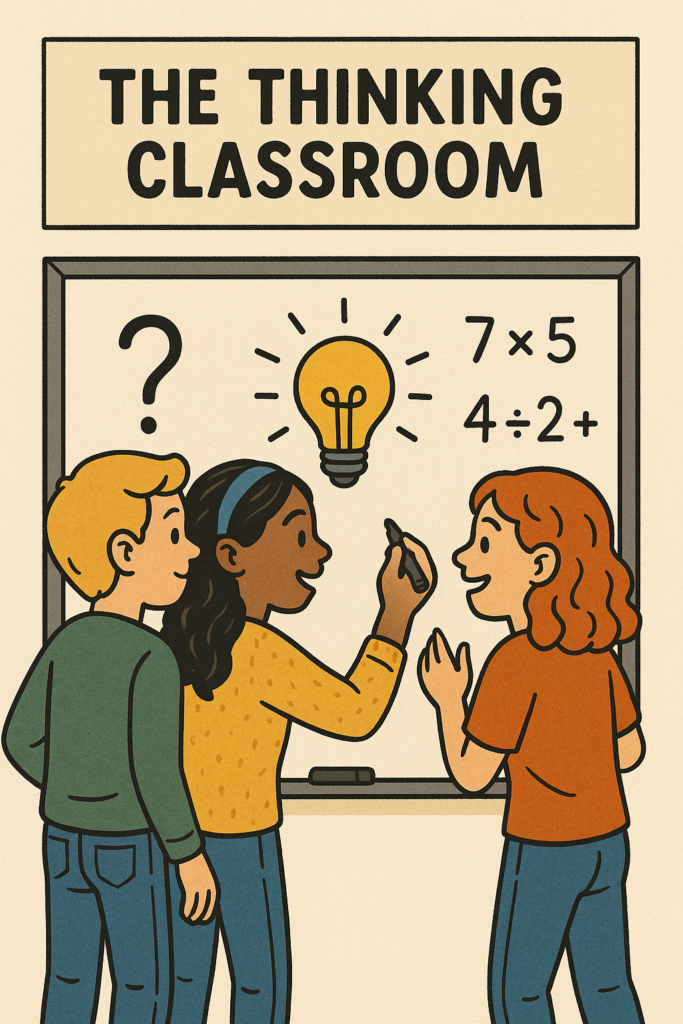
In short, the technique can be summarized as less teaching, no mimicking, and more thinking. Students work in groups of three, standing, writing on a whiteboard, with one marker per team. To get to where he did with this new approach, Peter Liljedahl questioned every institutional norm possible. He even had a classroom operate without furniture for a few weeks to research the impact of furniture… and he did that with everything. His approach is, in many ways, bulletproof.
The 14 Building Thinking Classrooms Practices are:
- What Types of Tasks We Use
- How We Form Collaborative Groups
- Where Students Work
- How We Arrange the Furniture
- How We Answer Questions
- When, Where and How Tasks Are Given
- What Homework Looks Like
- How We Foster Student Autonomy
- How We Use Hints and Extensions
- How We Consolidate a Lesson
- How Students Take Notes
- What We Choose to Evaluate
- How We Use Formative Assessment
- How We Grade
I just bought his book and it has been captivating. He goes in depth about just about everything. See it in action here. No one sitting on a chair. No. One.
Look, I have never been a math teacher, but it sounds amazing, and of course this technique can always be implemented alongside something else – whatever you feel your classroom needs. At its core, it works against “learned helplessness.” All the time, students are being told what to do, when to do it, and how to do it, with very little room for thinking, making mistakes, or figuring things out. Sure, some students will take that space, whether it comes naturally to them or because their parents encourage it at home. But most students won’t, and in a traditional classroom, an overwhelming majority won’t try to figure it out when it gets hard by trying, making mistakes, and trying again; they will just wait and see, or ask.
So this post is a little off topic, but also not, because students are standing up and writing, a strategy that, by the way, helps tremendously with thinking, engagement, and participation. And if the whole idea is not for you, that’s okay. It’s still a reminder that it can be easy to implement some kind of movement in your classroom that doesn’t need much space or have students sweating. If the Thinking Classroom method isn’t for you, perhaps try just having students work standing up when they are in a group!
Hope that helps!