To see the video created by my team and I on the social impacts of technology in the classroom, click here.
The Thinking Classroom that Doesn’t Sit
We’ve discussed ways to involve movement in numeracy and literacy classes, but I missed a big one. Or should I say I didn’t know about it then. But right now, it is the most captivating concept ever created by humankind to me.
I was recently getting my daily dose of the Cult of Pedagogy and listened to the most interesting episode (206): The Thinking Classroom: An Interview with Peter Liljedahl (click here for the blog post). Although you won’t see students jump up and down with this approach, it does get them up and about. It breaks sedentary habits and has huge benefits. The idea was researched (for 15 years!) and tested with more than 400 teachers, and was initially offered to math teachers.
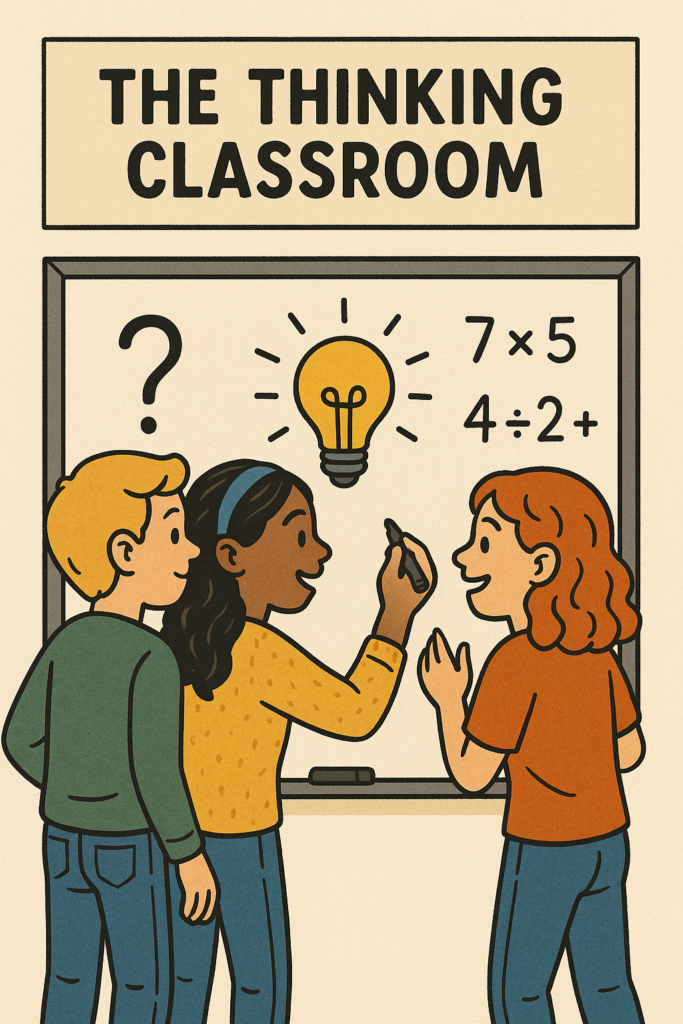
In short, the technique can be summarized as less teaching, no mimicking, and more thinking. Students work in groups of three, standing, writing on a whiteboard, with one marker per team. To get to where he did with this new approach, Peter Liljedahl questioned every institutional norm possible. He even had a classroom operate without furniture for a few weeks to research the impact of furniture… and he did that with everything. His approach is, in many ways, bulletproof.
The 14 Building Thinking Classrooms Practices are:
- What Types of Tasks We Use
- How We Form Collaborative Groups
- Where Students Work
- How We Arrange the Furniture
- How We Answer Questions
- When, Where and How Tasks Are Given
- What Homework Looks Like
- How We Foster Student Autonomy
- How We Use Hints and Extensions
- How We Consolidate a Lesson
- How Students Take Notes
- What We Choose to Evaluate
- How We Use Formative Assessment
- How We Grade
I just bought his book and it has been captivating. He goes in depth about just about everything. See it in action here. No one sitting on a chair. No. One.
Look, I have never been a math teacher, but it sounds amazing, and of course this technique can always be implemented alongside something else – whatever you feel your classroom needs. At its core, it works against “learned helplessness.” All the time, students are being told what to do, when to do it, and how to do it, with very little room for thinking, making mistakes, or figuring things out. Sure, some students will take that space, whether it comes naturally to them or because their parents encourage it at home. But most students won’t, and in a traditional classroom, an overwhelming majority won’t try to figure it out when it gets hard by trying, making mistakes, and trying again; they will just wait and see, or ask.
So this post is a little off topic, but also not, because students are standing up and writing, a strategy that, by the way, helps tremendously with thinking, engagement, and participation. And if the whole idea is not for you, that’s okay. It’s still a reminder that it can be easy to implement some kind of movement in your classroom that doesn’t need much space or have students sweating. If the Thinking Classroom method isn’t for you, perhaps try just having students work standing up when they are in a group!
Hope that helps!
Multi-Access/Hybrid Learning – After Thoughts
I found the class really interesting, but it left me a little tangled in my own thoughts. I like taking a critical perspective on what I hear instead of jumping into the “this sounds perfect” mentality. I’m trying to get ready to be a teacher, so think about everything in a concrete “how will I do that in my classroom?” manner, staying realistic. The conversation I’m referring to was about multi-access/hybrid teaching in classrooms. I wanted to ask my teacher at the end whether the discussion was focused on elementary teaching or more upper levels, like college or university, but after two hours in front of my computer, I decided to log off!
I always appreciate Valerie’s compassionate and considerate perspectives, which come not only from her personal and professional values but also from experience with her own kids. She brings up dimensions I don’t naturally think about. As an able-bodied young woman who’s never faced significant physical or mental health struggles, I tend to forget about other people’s realities. And that’s where my dilemma comes in.
Growing up, I watched my mom teach grade 1, raise two kids, exercise, assist to ALL my brother and I’s sports games, go on weekend trips, see friends, cook us breakfast, lunch, and dinner (with my dad of course… this is 2025!), and SO much more. I respect her even more now that I’ve had my own classroom, because I’ve seen firsthand how demanding teaching is. Teachers have so much on their plates and so many students to support… and just so much time.
In a perfect world, all teachers would adapt lessons to every student, teach through multiple approaches, encourage students to express themselves in different ways, match each student’s exact level, include some free inquiry projects, be culturally responsive, act as counselors, and, on top of that, make their classrooms accessible both in-person and online. But I really struggle to see how that can all be possible, while having kids, friends, a partner, and a family, as well as a physical and mental health to take care of. I want to be the best teacher I can be, and expect working countless after hours, I’ve seen and experienced it firsthand, but refuse to forget myself in the process. Therefore, sometimes, I find myself conflicted with the idea of specialized schools (or classrooms) for students who need more support, whether that’s for mental health or physical disabilities. On the one hand, they offer smaller class sizes, more resources, and teachers with specific training. These schools can give students the attention they need, reduce the stress and workload on teachers, and provide environments that are better adapted to particular needs. I feel like, for some students, being in a space where their differences aren’t what make them stand out can build confidence and make learning more manageable? Families may also feel more supported, knowing their child is in an environment tailored to them.
On the other hand, I also see how these schools can risk deepening the gap, and sometimes leave students feeling more “set apart.”
So I guess I’m just a little overwhelmed with all of these expectations piled onto a job that is already so demanding. I have scheduled a meeting with my teacher, and look forward to having her valuable input on those thoughts.
Pacific School of Technology and Innovation – After Thoughts

Visiting the Pacific School of Technology and Innovation was eye-opening, and also definitely confusing. I had, and still have, so many questions. After watching Most Likely to Succeed, I was fascinated by the concept, and I honestly thought it was one of the best ideas I had ever heard. I still think it is extremely innovative, inclusive, and interesting, but once the initial excitement settled, I decided to look at it more critically through my own lens as a future teacher, and according to my own personal believes, personality, and experiences.
For me, the big question is about balance. YES, students should be creative, think critically, follow their passions, work hard and learn to be autonomous. I love that this model seems to support all of that. But I also believe that school isn’t only about following our interests. Sometimes it means learning things even when we don’t naturally care about them. You might love space more than anything, but that doesn’t mean you shouldn’t learn about Canadian history. In fact, I think being exposed to a variety of subjects when you’re young is what helps you discover unexpected interests. Maybe you thought history was boring until one day you realize it’s actually not. Regardless, it’s important. I also believe that learning how to be bored or unmotivated and still follow through is an important life skill. I don’t think the Pacific School of Technology and Innovation model is for everyone. If I take myself as an example, I don’t think I would have had a strong enough passion at that age to research one topic all day, every day. Not all kids have a “thing” yet, and honestly, some people might never have one big passion, and that’s okay too.
Another downside in my opinion that I noticed, from my short observation, I noticed that most students were on their computers. Personally, that is not how I would want my students learning most of the time. I would definitely need to observe again before forming a strong opinion.
Despite my critics, I absolutely loved the idea of adapting learning to student interests, but, as I aim to work in public schools, I also question how realistic it is to expect one teacher to individualize everything for 30 students. That said, I am fully on board with pieces of it. I love the idea of genius hour. I also really like the idea of project-based learning where students still learn certain subjects but get to demonstrate their understanding in their own way, similar to what we saw in Most Likely to Succeed.
So overall, I am inspired but cautious. I do not want to romanticize something just because it feels progressive. I want to find a way to take the parts that, as of right now, I believe truly work and apply them in a classroom setting that feels balanced and realistic.
Most Likely to Suceed – After Thoughts
After watching the documentary Most Likely to Succeed, I found the concept fascinating and thought-provoking. The opening scene, where students sat in a circle struggling to share ideas, opinions, or reflections, felt like a very powerful representation of our generation. Looking at some of those students also even felt like looking at a mirror. It highlighted how traditional schooling often prevents students from practicing their decision-making skills and critical thinking. Too often, education is structured around black-and-white answers, leaving little room for freedom, creativity, or personal opinions.
This great documentary captured both the challenges and the potential of giving students freedom and autonomy. The striking growth shown by some of the students was spectacular. Although it was difficult to clearly see the traditional academic development they achieved, or whether the prerequisites for university were fully met for all, the film strongly portrayed the development of important soft skills in many of them. Watching students evolve from shy and hesitant to outgoing and well-spoken made it emotional to vicariously witness their growth.
It was also extremely relevant that the documentary highlighted statistics about how little students actually remember in traditional schools. Knowledge is often memorized for the exam and forgotten for life. This made the school in the film feel idealistic, eye-opening, and difficult to argue against.
After watching, I was left with the impression that all high schools should provide at least one year of this type of learning.